 What more is there to say?
Thursday, May 29, 2008

Monday, May 26, 2008
Doesn't like Fried Matzoh?

Most Thursdays, Peter's cousin, Melanie, comes over to have fried matzoh for lunch.
I dunno...looks like he's pushing it away, to me.
Miranda's Turn
When I was about 6 years old, my father bought 6 or 8 Kodak Instamatic cameras in a State (of California) auction of surplus property. I got hold of one and wandered around snapping all sorts of pictures...without any film in the camera. Well, with digital, you can do it all (well, at least you can actually take the pictures, but not "waste" any film).
So here's some of what Miranda shot yesterday.

The dining room table, set for Sunday lunch.

That whole "bowl of cherries...pits" thing.

Emily working at the adding machine.
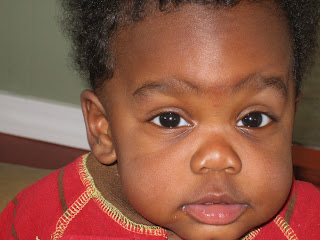
She also took some fun shots of Peter.


Miranda and Morality Play
Miranda replayed the Cold War on her floor.
 Ever intrepid, Freedom stands at the ready.
 Further from the camera, Commie is isolated, seemingly hesitant, and (we know, given the distance) about to be vanquished.
 Was it Freedom's Horn of Plenty, or Capitalist Hooves of Opportunity that did Commie in?
Oh, I forgot to mention, Miranda decided that Commie actually represented Canada. I'm not quite sure why, but mine is not to question why, and so on.
A couple of hoods
 Two who like the camera pretty well.
Jackson is honing his directorial talents, too. He made a short film for his social studies class. It's more title cards than live action, but with Microsoft's Movie Maker, you can do some quite fun things. I hope we don't have to start reading Cahiers du cinéma.
Someone's in the kitchen....
with Miranda. She made us a batch of snickerdoodles...
all by herself.

 Peter thought it was fun...until he didn't.

Sorry for the blurry. I tell myself it enhances the mood of the shot.
He likes the camera; he seems to respond happily and easily when it's around. Then again, he responds well to most anything--well, not so much the underwater dunk he does at the Y swim lessons, but he gets over it quickly.
Saturday, May 24, 2008
Washington, DC, redux
I finally got around to downloading the pictures from Jackson's camera, and he had some nice shots from the Washington trip in January.

This truly is a redux.... 30 years ago the same principals (with Jackson--the same age I was then-- standing in for me) struck this same pose in front of the Custis Lee mansion on the grounds of Arlington National Cemetery.

Jackson took several shots of the Washington Monument. These are my favorites.


I find this photo curious and interesting. That's the Vietnam Veterans Memorial--"The Wall." I've always found the wall a strangely moving experience. Moving because you can't escape its intensity. Strange because I can't quite fully understand everything I'm seeing, thinking, or feeling.
I knew nobody who died in service there, I even "disagreed" (after the fact) with the war, and yet when I look upon each name, engraved in the shiny black granite, I feel an acute sense of loss. I find it a perfect monument to an event that still has not been fully apprehended in the national consciousness. If you do a google search of "Vietnam syllabus," you'll see just how much we think, talk, and feel about this war.
So there's Jackson, in the yellow sweatshirt, reflected in the wall. He's standing next to his grandfather (blue hat with the yellow dot), and that might be his uncle Paul about to walk in front of them. A 12 year old, who understands the current American wars primarily for their consequence on the individual lives affected; his grandfather, who turned 18 in November of 1945 and served a year helping occupy the South Pacific; his uncle who turned 18 in 1970, a way station between the two, in which the strain between human consequences and grand--if still awful (necessarily evil?)--projects became most acutely felt in modern American life.
The perfect picture, then, of my own practical and moral uncertainty. Nicely done, Jackson.
Subscribe to:
Posts (Atom)